What kept changing our mind about heating a Carpathian eco-community
How site logistics killed our first idea, a ground loop almost brought it back, and forest ecology pulled us toward a fourth answer
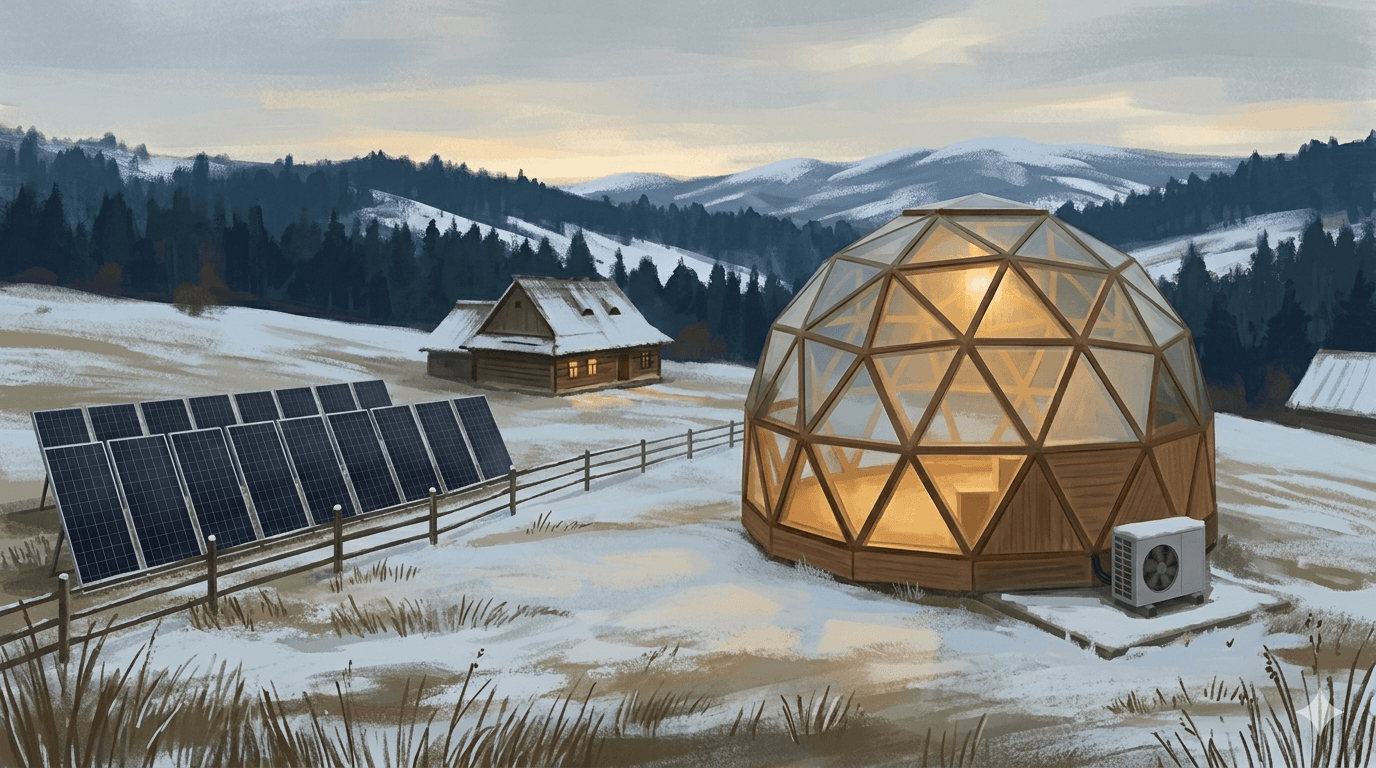
Every infrastructure decision at Tepla Gora starts with the same tension. The site is at 800 metres in the Ukrainian Carpathians, at the end of a rocky mountain road. Whatever we design has to work in a harsh continental climate: heating season from October through April, design temperature minus twenty, weeks of overcast skies, eighty to ninety percent humidity in winter. And whatever we design has to be buildable on a mountain with limited vehicle access.
This article traces how we worked through the heating system for Unity Hub, a three-story net-zero community building currently in design. The process involved a basement that could not be built, a wood boiler we tried to write out of the design, a geothermal option that won the argument on paper, and then a slow realisation that paper was wrong about something important.
We are publishing the thinking as it develops, because the tradeoffs are instructive even if the answers change.
Where to put the engine room
Before choosing a heat pump, we needed somewhere to put it. A building like Unity Hub needs a centralized equipment room: inverters, batteries, a heat pump, a buffer tank, circulation pumps, manifolds, and possibly a backup boiler with chimney. The original plan called for TeploHub, a separate insulated wood building near the workshop. Simple, proven, easy to build.
Then someone asked: what if we put all of this in a full concrete basement under Unity Hub?
On paper, the basement was perfect. It solved everything in one structure. Energy equipment, heating, ventilation, forty cubic metres of water storage in IBC tanks, greywater recirculation, general storage — all in one frost-protected underground space. No separate building, no buried heating pipes between structures, no heat transfer losses. Unity Hub would become the infrastructure hub for the entire community, distributing heat, power, and water to the hostel and future buildings from its own basement.
We spent weeks developing this idea. The functional advantages were obvious. The cost comparison was surprisingly close, because a full basement eliminates two or three separate construction projects (the equipment building, an underground water reservoir, and the buried pipe runs between them). The foundation was already planned as concrete pillars, so the step to a full basement seemed incremental.
The contractor's reality check
Then our building contractor did what contractors do: he checked whether the idea survived contact with the actual site.
Concrete delivery was the problem. A stationary concrete pump, the kind that pushes mixed concrete through hoses to where you need it, weighs seven tons and is not self-propelled. It cannot reach Tepla Gora. A concrete mixer truck can get within four to five hundred metres of the building site, but no closer.
Without mechanized delivery, all concrete work is manual. For a full basement requiring roughly eighty to a hundred cubic metres of concrete, that means 3,300 batches with a small on-site mixer, 260 tons of material moved by hand, eight to nine thousand wheelbarrow trips to distribute it across the foundation, and all of it lifted to 2.2 metres height for pouring columns, beams, and the ceiling slab. Our contractor said what any honest contractor would say: workers will refuse this job.
Basement variant: all equipment under Unity Hub. Rejected due to concrete logistics.
This killed not just the basement but any large-scale concrete project on the site, including the underground water reservoir that would have been needed in the original TeploHub plan too.
The theoretically optimal solution, everything integrated in one place, zero duplication, means nothing if it cannot be built. The right infrastructure for a mountain site is the infrastructure that can be built on a mountain.
We went back to TeploHub. Wood frame, carried up in pieces, assembled on site. Its concrete floor slab needs only five or six cubic metres — easily done by hand. The building grew from the original fifteen to twenty square metres to about thirty, because we added storage for ten glamping tepee tent sets that the community needs somewhere dry and lockable. Equipment in one half, storage in the other, with a fireproof partition between them.
Choosing the heat source
With the building sorted, the next question: what kind of heat pump?
The default answer in Ukraine is air-to-water. Widely available, many brands, local service, simple to install. You mount an outdoor unit on a pad, run refrigerant lines to the indoor unit, connect to the buffer tank, and you are heating. For most of the year, a modern air-to-water unit with an EVI compressor runs at a coefficient of performance around three to four, meaning three to four kilowatt-hours of heat for every kilowatt-hour of electricity.
But "most of the year" is not the problem. The problem is December through February.
At Tepla Gora in winter, air temperatures sit between minus five and minus twenty for weeks. Humidity runs at eighty to ninety percent. This is bad for an air-source heat pump. The outdoor coil ices up constantly. The unit runs defrost cycles, briefly reversing to melt the ice, which costs energy and reduces effective output. At minus fifteen with high humidity, COP drops to 1.5 to 2.0. At that point you are spending almost as much electricity as direct electric heating.
The standard solution is a backup wood boiler. Wood is essentially free at Tepla Gora. The surrounding forest produces deadwood that falls naturally, and collecting it is ecologically beneficial. A fifteen to twenty kilowatt boiler with a water jacket connects to the same buffer tank as the heat pump. When conditions get harsh, the boiler takes over.
This works. Many mountain communities heat this way. But when we listed the implications honestly, they added up:
Someone has to load the boiler. In cold periods, that means twice a day. At six in the morning, in minus twenty, someone walks to TeploHub and loads firewood. This is a community building, not a farmstead. There is no dedicated caretaker.
Firewood management is not zero effort even when the wood is free. Harvesting, transporting, splitting, stacking, drying. A hundred or more hours per year.
Wood burning produces particulates. PM2.5 from a wood boiler chimney near a building that contains a children's room, massage rooms, and a gym is a real health concern, not a theoretical one. Mountain valleys are prone to temperature inversions that trap smoke near the ground.
A building that regularly burns wood for heating does not meet the spirit of net-zero, even if the building envelope is excellent.
And our positioning as an applied research lab for sustainable buildings sits oddly with a system that relies on daily wood burning through winter.
None of these concerns are fatal on their own. Together, they made us look harder at the alternative.
The ground under our feet
A ground-source heat pump extracts heat not from air but from the earth. At one and a half to two metres depth, ground temperature in the Carpathians stays between eight and twelve degrees year-round — regardless of whether it is minus twenty or plus twenty-five on the surface. The heat pump always sees the same stable source. No defrost cycles. No capacity drop. No humidity problem. COP stays at four to five through the entire heating season.
The usual objection is cost. Ground-source systems require either deep boreholes (fifty to a hundred metres, drilled by specialist rigs) or horizontal ground loops (pipes buried in trenches across a large area). Boreholes are expensive. At Tepla Gora, they also raise a concern we take seriously: the community did not want to drill deep into the mountain for water supply out of concern for aquifer impact. Drilling for heat uses the same technique and raises the same questions. The boreholes are closed-loop and sealed, so the actual environmental risk is minimal with proper installation, but the concern is real and we did not want to dismiss it.
Horizontal loops avoid all of this. The pipes sit at one and a half to two metres — well above any deep water-bearing formations. No drilling, no aquifer interaction. The installation is basic excavator work: dig parallel trenches, lay polyethylene pipe, backfill. The pipe contains food-grade propylene glycol antifreeze in a sealed loop. Nothing enters the soil.
The catch is land area. A horizontal loop needs roughly forty to fifty square metres of open ground per kilowatt of heat extraction. For fifteen kilowatts, that is six to seven hundred and fifty square metres — a patch of meadow about twenty-five by thirty metres. It cannot be paved or built on afterward (the ground needs rain and snowmelt infiltration), and no deep-rooted trees can grow directly above (roots can damage pipes at that depth).
Two things made us look at this seriously.
First, Tepla Gora is purchasing an excavator for general site development. The trenching for a horizontal loop is exactly the kind of work this machine does. No specialist drilling contractor. No mobilization fee for equipment that comes once and leaves. The excavator is already there.
Second, the site plan showed open ground in exactly the right location. South-east of Unity Hub, between the building and the area where the septic system is planned, there is roughly six to eight hundred square metres of open meadow. The septic installation requires excavation in the same area. Combining both projects into one excavation campaign — dig the ground loop trenches and the septic pit in the same weeks, with the same machine — is an obvious efficiency.
The cost surprise
We expected geothermal to be significantly more expensive than air-source. The European pricing data we started with suggested the heat pump unit alone would cost twice as much, plus the ground loop installation on top.
Ukrainian market pricing tells a different story. Local manufacturers like GeoSun produce ground-source units at prices well below European brands. Turnkey geothermal installations, including vertical borehole drilling, advertise at under ten thousand dollars. With a horizontal loop and your own excavator, the ground loop cost drops to roughly one to two thousand dollars (pipe and antifreeze, the excavator is already paid for). The total system comes in at eight to fourteen thousand dollars.
An air-source heat pump plus wood boiler, the supposedly cheap option, costs eight to twelve thousand dollars when you add the boiler, chimney, combustion air ducting, and firewood infrastructure.
The price difference is small. In some configurations, the geothermal option is the same cost or cheaper. And it comes with much better winter performance and none of the wood-burning downsides.
What about the PV array?
In a separate analysis, we designed a twenty-kilowatt vertical bifacial PV system optimized for winter production. With an air-source heat pump running at COP 1.5 to 2 in winter, that array size was driven partly by the need to power an inefficient heat pump during the months when solar production is lowest.
Geothermal changes this. At COP four to five, the same heating output requires half the electricity. A fifteen-kilowatt array with geothermal provides roughly the same winter energy coverage as twenty kilowatts with air-source.
We considered reducing the array to save two to three thousand dollars and tens of metres of solar fence. Then we thought about what the extra panels buy: the ability to almost never run the wood boiler. With twenty kilowatts of PV, sixty kilowatt-hours of battery storage, a geothermal heat pump, and two grid connections as backup, the boiler becomes emergency-only equipment. Loaded once in autumn, checked monthly, fired up maybe zero to five days per year when the power goes out or the heat pump needs service.
The two to three thousand dollars in extra panels is cheap compared to a hundred hours per year of firewood management, the health impact of wood smoke near occupied buildings, and the credibility cost of daily wood burning in a building that calls itself net-zero.
Two buildings, two heating profiles
At this point we had a clean plan: geothermal heat pump in TeploHub, horizontal ground loop, everything piped to Unity Hub and the hostel.
TeploHub variant: all equipment in a separate building, 42 m from Unity Hub.
Then the team raised a question we had not thought through carefully enough. Unity Hub and the hostel have completely different heating needs. Unity Hub is a well-insulated NZEB building — four hundred and sixty square metres, floor heating on the first and second floors, warm air from the heat recovery ventilator on the third. It needs gentle, low-temperature heat: roughly twenty-eight to thirty-five degrees, well within passive-house range. The geothermal heat pump delivers this at COP four to five.
The hostel is a different story. It is a traditional hutsul heritage building — a hundred and thirty-one square metres, thin walls, sawdust insulation, leaky windows. It needs high-temperature heat delivered fast through radiators: fifty-five to sixty-five degrees. Pushing the geothermal heat pump to sixty degrees drops its COP to two-and-a-half to three, wasting efficiency on a building that loses most of its heat through the envelope.
The wood boiler, which we had just demoted to emergency backup, turned out to be the right primary heat source for the hostel. Not for Unity Hub — the whole point of geothermal is to avoid burning wood in the main building. But heating a seventy-square-metre heritage cottage with wood is what hutsul buildings have always done. It is culturally appropriate, practically sensible, and the wood is free. The boiler sits in TeploHub, twenty metres from the hostel, and the management burden is modest: loading a few times a week in deep winter for a small building, not twice daily for a large one.
This split heating strategy uses a stratified buffer tank. The heat pump feeds the middle of the tank at around thirty degrees. The wood boiler feeds the top at sixty to sixty-five degrees. Unity Hub draws from the middle. The hostel draws from the top. Both sources feed the same tank without conflict.
The hybrid solution
With two heat sources serving two buildings at different temperatures, the next question was where to put them. The original TeploHub plan put everything in one separate building, forty-two metres from Unity Hub. That worked, but it meant forty-two metres of buried insulated pipe carrying the primary heating supply for Unity Hub — with under five percent heat loss, but still a long run for the main circuit.
The team meeting that changed things was about something unexpected: shelter. Security personnel from the British Embassy, preparing a site visit, asked about shelter availability. A basement under Unity Hub, even a small one, would serve as a shelter — a practical requirement that keeps coming up with western visitors and partners working in Ukraine.
That triggered a rethink. A full basement was killed by concrete logistics (eighty to a hundred cubic metres). But a mini basement — just fifteen to sixteen square metres, a corridor with service niches between foundation columns — needs only seventeen to twenty cubic metres. Hard work, but buildable.
And if we are building a mini basement anyway, the heat pump and buffer tank are the obvious things to put in it. They benefit most from being inside Unity Hub: zero pipe losses for the primary heating circuit, short pipe runs to the floor heating manifold, direct connection to the heat recovery ventilator.
The wood boiler, batteries, and inverters stay in TeploHub. The boiler needs fire separation from the main building — if TeploHub catches fire, it is a thirty-square-metre outbuilding, not a four-hundred-and-sixty-square-metre community centre. Batteries do not typically catch fire, but they can produce toxic smoke during thermal events. Better to have that happen in an outbuilding. Glamping storage stays in TeploHub too.
The hybrid split: heat pump in Unity Hub's mini basement, wood boiler and batteries in TeploHub.
The heating mains between the buildings change character. The forty-two-metre pipe from TeploHub to Unity Hub is no longer the primary heating supply — it is a backup connection, used only when the wood boiler supplements Unity Hub during extreme cold or heat pump maintenance. The twenty-metre pipe from TeploHub to the hostel remains the primary supply for radiator heating.
When the answer changes
We thought we had landed on geothermal. Then four things happened in roughly two weeks that pulled us back toward the air-source option we had spent the previous month rejecting.
The excavator stopped being free. We had been planning to buy a small excavator for general site development. The trenching for a horizontal loop would happen alongside septic and water reservoir works at near-zero marginal cost. After running the numbers, we changed plans: we will rent an excavator for specific jobs instead of owning one. That removes the "free trenching" assumption. Renting a five-tonne machine for the five to ten days needed to dig a 750-square-metre loop adds roughly one to four thousand euros to the geothermal option. Not a deal-breaker, but it shifts the economic comparison.
The intuition about disturbing the mountain wouldn't go away. A horizontal loop is a one-time disturbance, and we wrote about that earlier in this article. Technically the meadow recovers. But Tepla Gora is a place where almost everything we build is meant to sit lightly on the landscape. Digging up 750 square metres of meadow at one-and-a-half-metre depth, even once, is the most invasive single act in the whole construction sequence. Whenever we discussed it, something kept feeling off. Not a rational objection — a values one. Worth taking seriously instead of arguing past.
The forest wants its deadwood removed. Carpathian forests produce far more deadwood than they can process. Removing it reduces fire risk, pest pressure, and lets younger trees establish. Local communities have always done this. Burning sustainably-harvested deadwood in a high-efficiency boiler is essentially using a resource that needs to be removed anyway. This reframes the wood boiler from "compromise we are trying to avoid" to "responsible local resource use."
Grid reliability matters in wartime. We had been treating the grid as a stable backup. In Ukraine right now, that is optimistic. Blackouts happen. A wood boiler that can heat the building independently of grid availability is not a fallback to mid-twentieth-century technology — it is wartime resilience. Geothermal is more efficient electrically, but if the grid is down for a week in January, more efficient consumption of zero kilowatt-hours is still zero kilowatt-hours.
The math at near-passive-house levels
When we redid the heating calculation properly, the gap between the two options was smaller than we initially claimed.
Unity Hub is being designed close to passive-house standard: peak heating load around ten to fifteen watts per square metre, or roughly four-and-a-half to seven kilowatts for the whole 460-square-metre building. With smart zonal heating that adjusts setpoints based on room occupancy — and a community building like this is rarely occupied uniformly — average winter thermal demand drops to about sixty to eighty-five kilowatt-hours per day. Cold January days reach about a hundred and thirty kilowatt-hours per day.
An air-source heat pump in deep Carpathian winter runs at COP one-and-a-half to two. To deliver eighty kilowatt-hours of heat on an average day, that is around forty to fifty kilowatt-hours of electricity. On a cold day, around seventy-five.
A geothermal heat pump at COP four-and-a-half delivers the same heat with around twenty to forty kilowatt-hours of electricity per day.
The absolute difference is twenty to forty kilowatt-hours per day. Significant, but not as overwhelming as the COP ratio suggests in isolation, because the underlying demand is small.
If we increase the photovoltaic array from twenty to thirty kilowatts of vertical bifacial panels, average winter daily production is sixty to ninety kilowatt-hours — enough to cover an air-source heat pump on average days, with some surplus charging the battery. The binding constraint becomes consecutive overcast cold weeks: maybe ten to thirty days per winter when the wood boiler in TeploHub supplements the air-source heat pump in Unity Hub. Not daily wood burning. Periodic backup during the worst weeks.
The current direction
We are now leaning toward air-source rather than geothermal, with a hybrid equipment split:
Updated hybrid split: air-source heat pump replaces geothermal, the rest stays.
In Unity Hub's mini basement: an air-source heat pump indoor unit (with the outdoor unit on a pad next to the building), a stratified buffer tank of one thousand to two thousand litres, a heat recovery ventilator with heating coil, and a laundry zone. The basement also functions as a shelter — fifteen to sixteen square metres, sized for thirty seated, extendable to fifty when laundry space is included. Foundation: forty bored piles regardless of basement scope. Walls: shlakoblock with external waterproofing. Floor insulation: foamglass where available.
In TeploHub (now five by seven metres, around thirty-five square metres): a modern gasification wood boiler — primary heat for the hostel, backup for Unity Hub — with an optional pellet auger to reduce manual loading. Battery storage of sixty-plus kilowatt-hours with inverters. Glamping storage, all behind a fireproof partition.
On the roof and fence line: thirty kilowatts of vertical bifacial PV optimized for winter production, up from the twenty originally planned. In the ground: two grid connections, treated as tertiary backup rather than primary.
The wood boiler exists for two purposes: it heats the leaky heritage hostel as its primary source, and it backs up Unity Hub during the worst overcast cold weeks of winter — perhaps ten to thirty days per season, not daily.
This is not the geothermal article we set out to write. It is the article a real construction project produces when site economics, environmental intuition, forest ecology, and wartime conditions all push in the same direction. We have not committed to this fully — the team is still discussing — but the direction is clearer than it was two weeks ago.
What we have learned is that "the right system" is not a fixed answer. It is the system that fits the site, the community, the moment in history, and the constraints we cannot wish away. When those change, the system should change with them.
We will update this article again. Probably not for the last time.
Update, September 2026: the fifth answer
We promised to update this article. Five months later the direction held, most of the equipment around it changed, and the building is out of the ground.
Air-source it is. The team adopted our heating concept as the project baseline in July, and the external engineer route was dropped. The unit is a 12 kW R290 air-to-water heat pump, downsized from the 16 kW first considered. Its compressor carries the building to about minus 18; a built-in 3 kW electric heater extends cover to about minus 25. Nothing has been ordered yet. An independent HVAC engineer is reviewing the heat-loss calculation, equipment specification, and floor-heating layouts before anything is bought.
The basement went, and the shelter with it. The mini basement did not survive the summer cost and structural review. The heat pump's indoor side now lives in a technical room on the first floor: plate heat exchanger, buffer, manifolds, and the ventilation unit. The outdoor unit stands on a pad beside the building. The shelter function that had revived the basement idea was not relocated.
The numbers were optimistic. This article assumed a passive-house class load of 10 to 15 W/m². The design calculation at minus 20, run room by room from the architects' model, gave about 10 kW in July and about 8.5 kW after the model's room placement was corrected in August, still provisional. That is roughly 17 to 20 W/m², about double the assumption. The heat pump choice survives because the peak moved down from the July figure, not up.
Smaller tank, warmer floors. The 1000 to 2000 litre stratified buffer became a 300 litre one, paired with a deeply modulating heat pump, plus a 100 litre indirect cylinder for hot water. All three floors now have underfloor heating: a wet screed on the ground floor, a dry strip system on the CLT slabs above without milling the panels. The yoga hall under the dome gets a fancoil for winter top-up. Heated walls were considered and dropped.
Frost is handled in two layers. Glycol runs only in the outdoor loop, separated from the building by a plate heat exchanger, so the indoor circuits stay clean water. Heating cable protects the outdoor pipes. The design accepts that a blackout at minus 20 with nobody on site is the case to survive.
Geothermal came back once, briefly. In August a partner institute proposed a dormant ground loop under the foundation slab, to be activated later. We turned it down on physics: no regeneration under a building, frost heave risk, and 8 to 12 degree brine cannot feed a 28 to 31 degree floor through a passive exchanger anyway. The rejection stands.
TeploHub exists. The equipment section is 5.3 by 4.3 metres, structurally complete, waiting for its floor screed and finishes, under a shared new metal roof with the workshop. The wood boiler is chosen: a pellet unit that can be reconfigured for logs. It remains the primary source for the heritage hostel and backup only for Unity Hub, to keep the net-zero claim honest. The 42 metre heat main between the buildings is a PEX pair. Battery storage is planned at about 47 kWh, not the 60 plus this article hoped for; the 30 kWp PV target stands.
On site. Ground works began in August 2026. The heat-loss model, floor-heating loop layouts, and ventilation routing are now generated from the building's BIM model by our own tooling rather than drawn by hand, and reviewed by the external engineer before they go to the contractor.
We will update again when the heat pump is running.
This research is part of Unity Hub energy system design at Tepla Gora. Related: Designing autonomous sanitation for a remote eco-community, Designing autonomous water supply for a Carpathian eco-community, Designing a winter-optimized PV system for a Carpathian eco-community.
Article Details
- Published
- April 25, 2026
- Updated
- September 20, 2026
- Related Project
- UA Unity Hub