Designing autonomous water supply for a Carpathian eco-community
How an inventory of five water sources, two research dead ends, and a rainfall calculation changed our approach to water autonomy
Water supply is the kind of problem that looks simple until you try to solve it for real. In a city, you open a tap and water appears. In a remote mountain community with no municipal connection, the question turns into something else entirely: where does this water come from, how much can we collect, how do we store it through dry and frozen months, and what quality does each use actually require?
We are working through this at Tepla Gora, an eco-community in the Ukrainian Carpathians. The community sits at the end of a kilometre-long rocky mountain road. There is no municipal water supply. The site has a stream, a pond, a shallow well, a spring, and a set of IBC tanks collecting rainwater from rooftops. These sources have kept a small team going, though water scarcity has been a recurring problem year-round for the past couple of years. But Tepla Gora is growing. Unity Hub (a three-story net-zero community centre) is in design, ten or more tiny houses are planned, and summer events already bring 50-300 people to a site with 9 cubic metres of stored water.
We needed more than "buy more tanks." We needed to understand the water system as a whole.
Starting with what we have
We began by mapping every water resource on the site. The annotated site map shows five distinct sources, each with different reliability, quality, and seasonal behaviour.
The stream runs along the northern boundary. It is the biggest volume source when it flows, but it dries in summer drought and freezes in winter. One intake point already captures stream water; a second intake further upstream could access cleaner water before it picks up sediment.
The pond sits in the northwest corner, where there used to be a marshy patch. The community dug it out as a recreational feature and an experiment: would it fill naturally, without piping water in? It did. The question of whether pond water could also serve the buildings came up naturally as we started planning for expansion.
The shallow well (about 10 metres) and a spring in the southeast provide supplementary water, but neither has enough yield to serve as a primary source.
VodaLab is a repurposed root cellar (пивниця) housing 9 m3 of food-grade IBC tanks. The stone walls and earth cover keep the water above freezing in winter and cool in summer. It is fed by roof collection and stream intake, and it is the backbone of the current household water system. It works for daily use, but 9 m3 is only two to three days of supply when an event or festival is running.
The first dead end: pond water for household supply
The idea was straightforward. The site already has a pond. A second, larger pond could store significant volume. Pipe it to the buildings, filter it, use it for showers and sinks. Maybe even drinking water with the right treatment.
We researched this thoroughly. The conclusion was clear and somewhat brutal.
An open clay-bottom pond with surface runoff is, by contamination profile, equivalent to a surface water body. Fine clay particles create persistent turbidity that clogs filters rapidly and impairs UV disinfection (the particles shield microorganisms from the UV light). Surface runoff introduces microbial contamination: animal waste, soil bacteria. The open surface invites algae, insects, and bird contamination. Ukrainian drinking water standards (DSanPiN 2.2.4-171-10) require turbidity below 1.0 NTU and absent E. coli. An open clay pond cannot reliably meet these numbers without a multi-stage treatment process.
To make pond water safe for even household use (showers, not just irrigation), you would need: coagulation to bind the fine clay particles, flocculation, settling, sand filtration, and disinfection. For drinking quality, add regular laboratory testing. That is a mini water treatment plant. Not impossible, but completely disproportionate to the problem when better options exist.
The existing pond already covers technical needs: irrigation, cleaning, fire reserve, construction water. Building a second pond would duplicate these functions without solving the household supply problem.
An obvious follow-up: what if we lined a new pond with EPDM rubber to eliminate the clay? That removes one problem (turbidity from the substrate) but not the others. A lined pond is still an open water body. Surface runoff still washes in. Algae still grow in sunlight. Birds, insects, and organic debris still land in it. You would still need the full multi-stage treatment to reach household grade. An EPDM liner is not cheap either, so you end up paying for an expensive liner and an expensive treatment system. Worse than either option alone.
Pond water is technical water. Period.
This was useful because it narrowed the field. Instead of chasing a source that would always need heavy treatment, we could focus resources on the cleanest source available.
The cleanest source is already falling from the sky
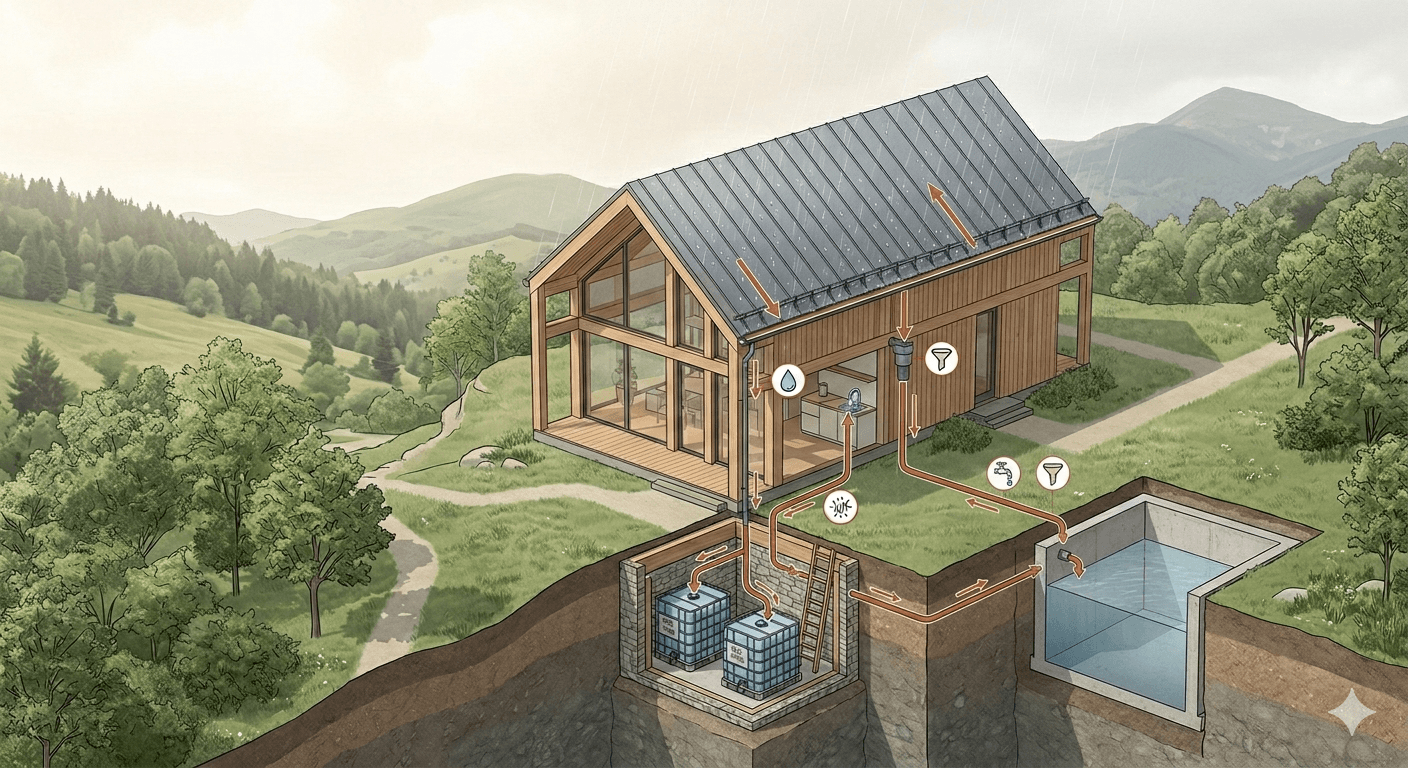
Rainwater collected from clean metal roofs is qualitatively different from pond or stream water. It has no soil contact, no surface runoff contamination, minimal turbidity. There is a catch, though: some of the existing roofs at Tepla Gora are not metal but old asbestos-cement (шифер). Asbestos roofs cannot be used for drinking-grade collection. Replacing them with metal is a first priority, and it also improves the aesthetics of the site. With a first flush diverter (which discards the initial dirty wash from the roof), closed storage (dark, food-grade, sealed from insects), mechanical filtration, and UV disinfection, roof rainwater can be brought to drinking quality. This is a well-documented treatment chain, not experimental technology.
The question was whether the numbers work. How much roof area does the site have, and how much water does it actually yield?
The Carpathians receive 600-1000+ mm of rainfall per year. Using a conservative 800 mm, a metal roof with 0.8 runoff coefficient yields 0.64 m3 per square metre per year.
We inventoried the roofs:
- 150 m2 of existing roofs already connected to rainwater collection: ~96 m3/year
- 150 m2 of existing roofs not yet connected: another ~96 m3/year
- Unity Hub and 10 planned tiny houses would add approximately 500 m2: ~320 m3/year
Total potential with all planned buildings: roughly 800 m2 of collection surface, yielding approximately 512 m3/year.
At the 20-person summer baseline of 1 m3/day, 512 m3 covers the entire year with margin. Even the existing 300 m2 (if fully connected) yields 192 m3 — enough for 192 days of baseline operation.
Here is what we kept coming back to: Tepla Gora does not lack water. It lacks storage. Rain falls in bursts, sometimes heavily for days, then nothing for weeks. The stream amplifies the same pattern. Without enough storage to buffer these cycles, the site runs dry between inputs even when the annual total is more than sufficient.
Design by quality, not by source
The second useful idea came from permaculture water design: not all water needs to be drinking quality. Matching quality to use changes the economics of the entire system.
Tier A — Drinking and cooking. The highest standard. Small volume (a household of four uses about 10-15 litres per day for drinking and cooking). Source: roof rainwater through the full treatment chain. Periodically lab-tested.
Tier B — Household use (showers, sinks, laundry). Must be pathogen-free and low-turbidity, but does not need to meet drinking standards. Source: roof rainwater with basic filtration and disinfection, or stream water (when available) after settling and treatment.
Tier C — Technical (irrigation, cleaning, fire reserve, construction). No treatment beyond basic screening. Source: pond water, surplus treated effluent from the septic system, stream water with minimal processing.
This tiered approach means the expensive treatment (filters, UV, lab testing) applies only to a small volume of drinking water. The bulk of daily consumption — showers, laundry, cleaning — uses a simpler treatment chain. And the largest volume uses (irrigation, construction) draw from sources that would otherwise go unused.
The storage bottleneck
Nine cubic metres of IBC tanks covers a small off-season crew (2-4 people), but even that has been tight. With Unity Hub, the off-season picture changes: winter events could bring up to 30 people for a week, once a month. Summer events need 1-2.5 m3/day. A week-long festival with 300 people could consume 5-15 m3/day, up to 105 m3 total. The gap between 9 m3 of storage and these demand scenarios is where the strategy had to focus.
The obvious near-term answer: more IBCs. Modular, cheap, replaceable, proven. Moving from 9 m3 to 20-30 m3 would provide a one-to-two week buffer at summer usage. But the bottleneck is not the tanks themselves. It is winter-ready space. VodaLab (the root cellar) is already full at 9 m3. Adding more IBCs means building another insulated, frost-protected space to put them in: a new root cellar, or something similar using excavated earth from another project, or another form of natural insulation. This needs research. And once you are building new underground insulated space anyway, the question becomes whether an underground reservoir (30-50 m3 in a single structure) ends up cheaper and more reliable than another cellar full of plastic cubes.
Medium-term: underground reservoir. The sanitation design already includes a centralized aerobic septic tank (20-25 m3) built underground by the community — excavated pit, concrete floor, brick or block walls, waterproof membrane, ceiling, backfill. The same construction method, with potable-grade lining instead of septic-grade, could create a 30-50 m3 water reservoir alongside it. This option is already referenced in the sanitation proposal. The open question is cost — a builder's estimate, requested alongside the septic quote, will determine feasibility.
Complementary option: insulated water tower. An elevated tank (3-10 m3) on an insulated raised structure provides gravity-fed pressure — 3-5 metres of height gives 0.3-0.5 bar, enough for basic household fixtures. No pump needed for daily use. Works during power outages. Smaller volume than underground storage, but serves a different function: daily buffer for high-quality water, gravity-distributed, while the underground reservoir handles seasonal bulk storage.
The septic connection
The centralized aerobic septic system designed for the community's sanitation produces treated effluent that could become a water resource. (Both the centralized septic and this reuse idea were later dropped; see the September 2026 update below.) The obvious idea is to return treated water to toilet cisterns, closing the loop on the single largest indoor water consumer. But this is still an open question. The actual quality of treated effluent is not yet confirmed, and pumping it all the way from the septic back to Unity Hub may not be practical. Greywater from sinks and showers, collected closer to the building, might be a simpler source for toilet flushing. What is more certain: surplus treated effluent, rich in nutrients, goes to garden irrigation as fertigation, and excess flows through the bioplateau into the landscape. If toilet flushing (about 30% of indoor use) ends up running on recycled water of either kind, fresh water demand drops by roughly 25-35%.
What is still debated
The deep well. This remains an open question within the community. One quote came in at ~$4,500. Drilling will find water, but the yield is unclear, which makes the well unreliable as a source.
Against: expensive, and the unpredictable yield means you might spend $4,500 and end up with a trickle. Deep extraction removes water from aquifers rather than working with natural surface water cycles, which is a philosophical departure from the community's permaculture principles, and carries a real risk of negatively affecting the local aquifer system.
For: a reliable year-round source independent of weather and season. Once established, minimal maintenance. Could serve as an emergency backup when surface systems fall short.
We treat the deep well as a last resort. It is compatible with the rainwater-first strategy (well water feeds into the same storage and distribution system), but the combination of cost, ecological risk, and uncertain yield makes it hard to justify when the alternative is expanding collection and storage.
Reducing demand at peaks
The hardest scenario is not daily operation — it is the annual festival. Three hundred people for a week could consume more water than the site uses in a typical month. Building storage capacity for this single event would be inefficient.
Instead, the strategy reduces peak demand directly. Composting toilets for festival guests eliminate the largest per-person water consumer. Water-saving showerheads (6-8 L/min instead of the standard 12-15 L/min) cut shower water by half. Separated drinking water points serve high-quality water in small volumes while technical water handles everything else. A documented festival water protocol — composting toilets, economy showers, three-basin dishwashing, timed shower slots — can cut peak demand by 30-50% without compromising the experience.
The landscape long game
There is one more layer to the strategy, and it operates on a different timescale.
The stream drying in summer is almost always a sign that rainfall leaves the catchment too quickly — running off the surface rather than infiltrating the soil and recharging the subsurface. If the landscape's water-holding capacity improves, the stream holds longer into dry season, the well and spring may increase their yield, and new seasonal seeps may appear.
Swales and contour channels on stable slopes slow surface runoff and allow infiltration (placed carefully, since Carpathian slopes can be landslide-prone). Infiltration trenches above the well and spring recharge their water table. Small check dams in stream gullies — a technique sometimes called beaver dam analogs — slow flow, trap sediment, and raise the local water table. Mulching and understory restoration reduce evaporation.
None of this adds 10 m3 of usable water tomorrow. But over one to three seasons, it can fundamentally change how water moves through the site. The largest tank is the soil itself.
What comes next
The strategy is now a working document for community discussion. The immediate priorities are practical: replace asbestos roofs with metal (doubles as an aesthetics upgrade), connect the remaining rooftop area, install first flush diverters, draft the festival water protocol. Storage expansion needs more thought, since the existing root cellar is full and any new IBC space requires building a frost-protected structure first.
The bigger investments — underground reservoir, water tower, deep well survey — depend on feasibility assessments and community decisions. The underground reservoir quote will be requested alongside the septic construction quote, since the same builder and the same construction method apply to both.
Every new building — Unity Hub, each tiny house — will be designed as a rainwater collector from day one. This is now a standard requirement, not an afterthought.
The problem we started with was "not enough water." The problem we actually have is that we are not collecting and storing the water that already falls here. Once we saw it that way, the plan became obvious.
Update, September 2026: what the community chose
Seven months later the strategy above is still our position. It is not the community's plan. Recording the gap honestly is more useful than pretending the document settled anything.
The well won. The team took the deep well as the primary source for Unity Hub's future and dropped rainwater-first in a budget round in June. A driller has visited, chosen the position, and estimated a depth of about 50 metres. Nothing has been drilled yet. We argued against it in this article and we still do, for the same reasons: cost against an uncertain yield, and drawing down an aquifer instead of catching what falls on the roofs. The decision stands, and we respect it.
The reservoir and the tower are gone. The 30 to 50 m³ underground reservoir was dropped for lack of budget. The insulated water tower went with it. The community-built concrete septic that would have shared the excavation and the builder was replaced by a factory tank serving Unity Hub alone, so the shared-construction argument fell away too (the sanitation article carries that story).
Toilet flushing with treated effluent is off. Tested against the real site geometry in August, the idea failed on pumping distance and lift, and it was not revived when the septic moved next to the building. Unity Hub will flush with fresh water.
Unity Hub draws from VodaLab. The water source for the building is settled: VodaLab, about 40 metres away and 10 to 15 metres lower, through a buried polyethylene line already purchased. The pump station will sit at VodaLab or run as a booster in series with the existing one; that choice waits on a measured height difference. Inside the building: sixteen water points, hygienic showers only in the two inclusive bathrooms, no hot-water recirculation. Treatment stays upstream at VodaLab; the building gets metering, a filter, and a leak-sensing master valve at the entry.
The roofs got better, and that is the irony. The workshop lost its asbestos roof. TeploHub, the new boiler house, was built right beside the workshop, and one large new metal roof now covers both buildings. That is exactly the clean collection surface this article asked for, sitting a short distance from the well that will be drilled instead of connecting it.
The situation on the ground got worse. Water shortage at Tepla Gora is now acute rather than recurring. Visitors falling ill from the water is not new at Tepla Gora, and it gets worse whenever demand peaks, most likely because doubtful sources come into use once the clean ones run low. A small festival this summer followed the same pattern. The festival water protocol from this article was not drafted. That protocol, first-flush diverters, and connecting the new metal roof to storage remain the cheapest steps available, and none depends on the well.
What held. Pond water is technical water. Quality tiers still shape every decision inside Unity Hub. The diagnosis is unchanged: the site does not lack water, it lacks storage and collection. The landscape long game has not started, and the stream still dries in summer.
This investigation is part of the water supply and infrastructure design within the UA Unity Hub project at Tepla Gora. Related: Designing autonomous sanitation for a remote eco-community.
Article Details
- Published
- February 28, 2026
- Updated
- September 19, 2026
- Related Project
- UA Unity Hub