Designing a winter-optimized PV system for a Carpathian eco-community
Why the standard approach to solar fails in the mountains, and what the physics of diffuse light and snow albedo suggests instead
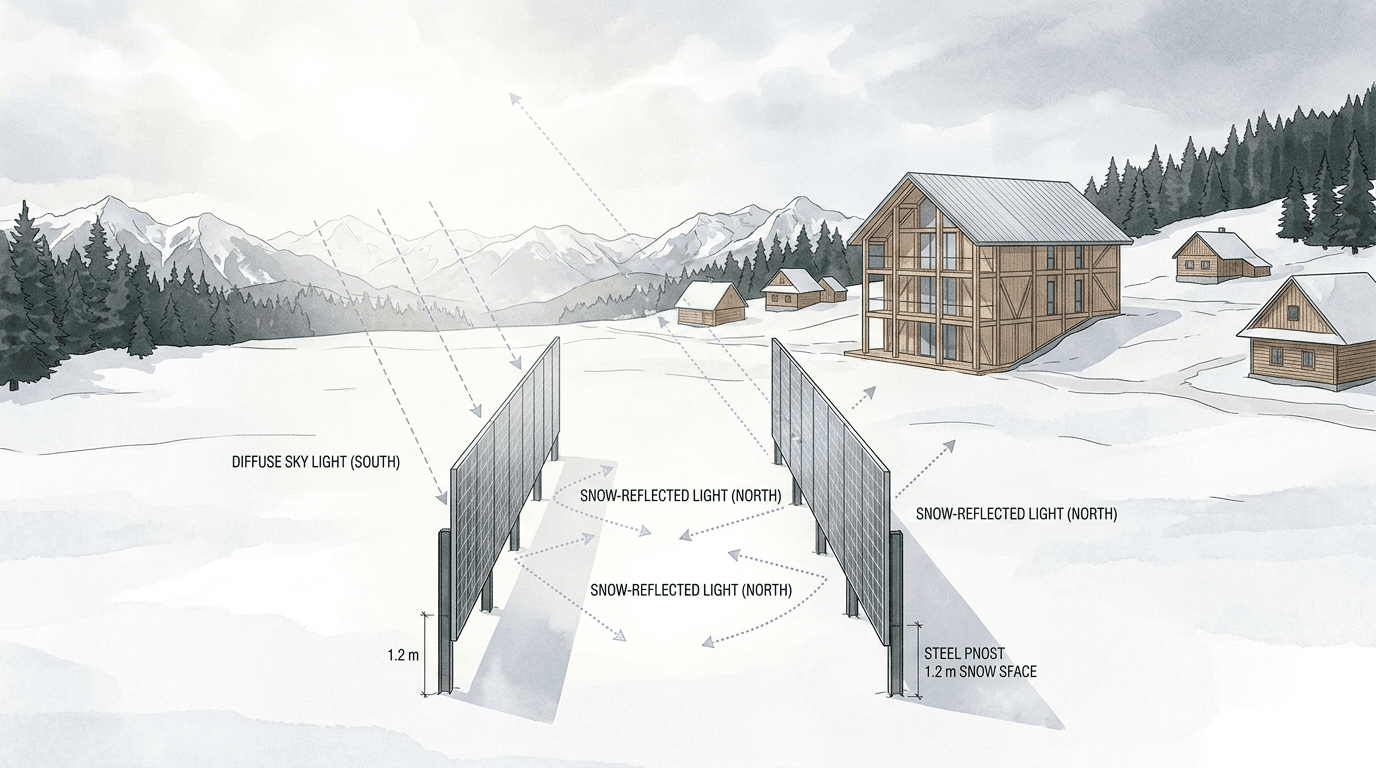
Every solar panel installation guide starts with the same advice: face south, tilt at your latitude minus 15 degrees, maximize annual yield. For most of Europe, this is sound. For a grid-tied home, summer surplus offsets winter deficit through net metering or feed-in tariffs. The annual total is what matters.
At Tepla Gora, none of that applies. The community is building Unity Hub, a net-zero building in the Ukrainian Carpathians. The site has grid connections, but the goal is maximum practical autonomy — the system should run without relying on the grid. Every kilowatt-hour that has to be bought from the grid is a design failure. In July, when the batteries are full by noon and the heat pump sits idle, excess solar production has limited value. In December, when heating demand peaks and the sun barely clears the southern tree line, every locally generated kilowatt-hour is critical.
We needed a PV design optimized for winter. The research took us somewhere we did not expect.
The Carpathian winter problem
December and January in the Carpathians share a pattern that most PV models handle poorly. Days are short, about eight hours of nominal daylight. The sun stays low, barely 18 degrees above the horizon at solar noon. But the real issue is not geometry. It is weather.
In a typical Carpathian December, clear sky — the kind where you can see the sun as a disk — appears maybe two or three days per month. The remaining 28 days are overcast. Thick cloud layers, fog in the valleys, falling or accumulated snow. The usual solar radiation models, which estimate production based on direct normal irradiance and tilt-adjusted beam radiation, overweight those rare clear hours. They suggest that a steep south-facing roof mount is the obvious answer.
And on an annual basis, they are right. A steep south-facing roof mount does produce the most kilowatt-hours over twelve months.
But we are not optimizing for twelve months. We are optimizing for December and January, when the building needs energy most and gets it least.
Three configurations, one question
We set up a comparison using PVGIS data for a representative Carpathian point: 48.5 degrees north, 24.5 east, about 758 metres altitude. The database was PVGIS-SARAH3 (2005-2023) with DEM horizon profiles that account for terrain shading from surrounding mountains. All figures are per kilowatt-peak installed, system losses zeroed out to isolate the geometry.
Configuration 1: conventional winter mount. Monofacial panels on the roof, south-facing, 65 degree tilt — a steep "winter angle" designed to catch low sun. Combined December and January yield: about 104.6 kWh per kWp. This is the textbook answer. One condition: you have to keep the panels clear of snow.
Configuration 2: vertical bifacial, east-west faces. The panels stand upright on the ground like a fence, running north-south. One face looks east, the other west. Combined December and January yield with bifaciality: about 45-52 kWh per kWp. Less than half the conventional setup. The problem is straightforward: in winter, the sun spends its entire arc in the southern half of the sky. An east-west split misses the middle of the day, when available light is highest.
Configuration 3: vertical bifacial, south-north faces. Same upright fence, but rotated 90 degrees — the panel runs east-west, one face looks south, the other north. The south face alone (monofacial equivalent) yields about 96.6 kWh per kWp: 92 percent of the rooftop option, with no snow clearing. Add the rear (north) face collecting diffuse sky light and snow-reflected light, and the estimated combined yield rises to 97-117 kWh per kWp. (PVGIS does not model bifacial panels directly — the rear-side contribution is our engineering estimate based on assumed bifaciality factor and local albedo conditions.)
That last number caught our attention. A vertical ground-mounted panel, with no access issues and no snow accumulation, performing at the same level as an ideal roof mount that requires regular cleaning?
We wanted to understand why. And whether the numbers hold up.
What the panels are actually collecting
The answer is in what kind of light is actually available in a Carpathian December.
Standard PV design assumes a mix of direct and diffuse radiation, with direct dominating on clear days. The panel angle and orientation are tuned to intercept the direct beam at a favorable angle. This works in climates with regular sunshine.
In the Carpathians in December, there is almost no direct beam to intercept. Two to three clear days out of thirty means roughly 90 percent of the monthly light arrives as diffuse radiation, scattered by clouds and distributed across the sky.
In the simplest model — isotropic diffuse, meaning light arrives equally from all directions — a panel's output depends only on how much sky it can see. The formula is clean: the sky view factor is (1 + cosine of tilt) divided by 2. A horizontal panel sees the full sky dome and captures 100 percent of the diffuse horizontal irradiance. A vertical panel sees half the sky and captures 50 percent. A 65-degree tilt captures about 71 percent.
If diffuse light were the whole picture, a 65-degree tilt would beat vertical by 42 percent, and no ground-mounted vertical system could compete with a roof mount. End of discussion.
But diffuse light is not the whole picture. Two things change the math.
The sky is not uniformly bright
Real overcast skies are not evenly lit. The patch of sky where the sun hides behind clouds is measurably brighter than the rest — atmospheric physicists call this circumsolar brightening. In winter, the sun stays in the southern sky all day. So the southern hemisphere of the sky is consistently brighter, even on days when you never see the sun directly.
Standard radiation models like Hay-Davies and Perez decompose diffuse radiation into isotropic and directional components. When clouds are very thick and uniform, the directional component is small. When they thin out, even partially, it becomes significant.
This means that south-facing surfaces collect more diffuse light than north, east, or west-facing ones. Not dramatically more on any single day, but consistently more across the month. It is why Configuration 3 (south-north faces) outperforms Configuration 2 (east-west faces) even when "there is no sun to face."
Snow changes the other half of the equation
The second factor is ground-reflected light. Every surface reflects some fraction of incoming light back upward. This reflected light reaches tilted and vertical panels from below.
In summer, the ground is dark: grass, soil, wet leaves. Albedo (reflectivity) around 0.2 — it absorbs 80 percent and reflects 20 percent. For a vertical panel that sees more ground than a tilted panel, this is a penalty. Less sky, more dark ground.
In winter with snow cover, the ground turns into a mirror. Fresh snow has an albedo around 0.8 to 0.9 — it reflects 80-90 percent of the light that hits it. Aged snow sits around 0.6-0.7. At Tepla Gora, where snow covers the ground from November through March, this reflected component becomes substantial.
The combined collection factor for sky diffuse plus ground reflection works out to:
(1 + cosine beta) / 2 + albedo times (1 - cosine beta) / 2
With snow (albedo 0.8), a vertical panel collects about 90 percent of the theoretical maximum. A 65-degree tilt collects about 94 percent. The gap shrinks to roughly 5 percent.
Without snow, the gap is 28 percent. With snow, 5 percent. Snow cover nearly eliminates the geometric disadvantage of being vertical.
And vertical panels have one absolute advantage that no amount of tilt optimization can match: they do not accumulate snow. A panel at 65 degrees on a roof gets buried. A vertical panel does not. In the Carpathians, where a snowfall can leave 20-30 cm on a roof surface overnight, and where clearing that snow means climbing onto a steep roof in freezing conditions, the practical difference is large.
What this means for placement
If vertical bifacial panels are not "sun catchers" but "sky-and-snow catchers," the placement logic changes.
Traditional PV siting focuses on avoiding shade from obstacles that block direct sunlight. The critical hours are around solar noon, and the critical obstructions are things between the panel and the sun's path.
For diffuse-light harvesting, the concern is different. What matters is how much of the sky dome the panel can see (from both faces), and how much bright ground (snow) surrounds it. The placement rules that follow from this:
Face south where possible. Not because the sun is there (it usually is not, behind clouds), but because the southern sky is brighter on average. If terrain or trees make due south impractical, small deviations cost little.
Maximize open, snow-covered ground on both sides. The rear face of a bifacial panel collects light reflected from the ground behind it. If the back faces a dark forest wall, that collection drops to almost nothing. An ideal site has open, snow-covered ground extending several metres in every direction from the panel.
Avoid nearby dark surfaces: dense tree lines, dark hillsides, buildings, anything that absorbs light and blocks sky view. A tree line 10 metres away and 15 metres high can cut visible sky by 20-30 percent on that side.
Mount above the snow line. The panel bottom edge needs to clear the maximum expected snow drift height. At Tepla Gora, that is somewhere between 1.0 and 1.5 metres, depending on the specific location and wind exposure. Getting this wrong means the bottom of the panel gets buried, which partially shades cells and can disproportionately reduce output.
Account for wind. A vertical panel is a sail. The Carpathians see strong winter winds at exposed elevations. The mounting structure needs to handle sustained loads and gusts without fatigue. This is not a place for lightweight residential racking systems.
Where this fits in the energy design
Tepla Gora currently has about 3 kW of solar panels. For Unity Hub, we are thinking closer to 20 kW — the site has space, panels are cheap, and oversizing PV is one of the simplest ways to improve winter performance. Even at low winter yields, a larger array produces meaningful energy.
PVGIS gives about 31 kWh per day from a 20 kW vertical south-facing array in December-January (monofacial only). Adding our bifacial estimate pushes that to maybe 35-38 kWh — but that part is unverified. A more conservative gut check — roughly 1/10 of peak output on overcast days plus some bifacial and albedo gains — lands closer to 20-25 kWh. The real number depends on local conditions we have not measured yet. Either way, somewhere in the 20-38 kWh range from a 20 kW array is a meaningful contribution to a building's winter energy budget.
Battery storage in the current spec is 30-40 kWh, which feels like a bare minimum. Something closer to 60 kWh would give more comfortable overnight autonomy, especially in multi-day overcast periods. On the other hand, with a large enough PV array, battery sizing becomes less critical — there is more energy coming in during daylight hours, so less needs to be stored.
Wind turbines were part of the original energy concept, but we are reconsidering. They have real downsides: mechanical complexity, maintenance at height, noise, visual impact, and regulatory questions. PV panels have none of these problems. They sit quietly, need no maintenance, and scale linearly — if you need more energy, you add more panels. With enough ground-mounted vertical bifacial capacity and adequate batteries, wind may not be necessary at all. This is still an open question, but the economics and simplicity of PV keep pulling in that direction.
What we do not know yet
The PVGIS numbers in this analysis use generic terrain data. The actual horizon at the specific panel location could be better or worse. A site visit with wide-angle horizon photos would let us run realistic simulations.
We have not selected specific panels. Bifaciality factor varies from 0.65 to over 0.90 depending on cell technology. N-type cells (HJT, TOPCon) currently offer the highest bifaciality. The choice affects the rear-face contribution directly.
The wind load question is real. Vertical panels in an exposed mountain location need proper structural engineering, not a task for rules of thumb.
And we have not priced this. Ground-mounted vertical bifacial systems with deep anchors are not the cheapest PV configuration. Whether the winter performance advantage justifies the cost premium depends on numbers we do not have yet.
The plan is to start with a test installation: one or two panels, instrumented, running through a winter season at the site. Real data from the actual location will tell us more than any simulation.
Stepping back
Standard PV design works for standard conditions: grid-tied, temperate, annual optimization. None of those apply at Tepla Gora. When we stopped asking "what is the best annual yield?" and started asking "what actually delivers energy in December?", the answer shifted to a configuration that no standard sizing tool would suggest.
The physics was already known. Diffuse radiation models, albedo corrections, bifacial gain calculations, none of this is new in the literature. What surprised us was the practical conclusion: in a climate dominated by cloud cover and snow, the optimal winter PV design looks nothing like the optimal annual PV design. The difference is large enough to change the technology choice entirely.
Whether vertical bifacial panels end up being the right answer for Tepla Gora depends on costs, structural feasibility, and actual on-site performance. The physics supports it. The next step is finding out whether the engineering and economics do too.
Update, September 2026: where the design landed
Six months on, the physics in this article has not been challenged. The plan around it has changed shape, and most of it is still on paper.
The array is a split, not a fence. The pure vertical-bifacial layout gave way in June to two sub-arrays. One part goes on a roof at a steep 60 to 70 degree winter tilt, with cleaning decks so snow can be cleared without climbing. The rest stands vertical on the ground around the hostel and along the site boundary, where the terrain lets winter sun through. The roof part behaves as monofacial, since its rear is blocked; the vertical part keeps the full bifacial and snow-albedo gain. Each orientation gets its own charge controller.
The roof arrived before the panels. The workshop lost its asbestos roof, TeploHub was built right beside it, and one large new metal roof now covers both buildings. That is the roof array's home. The first ten or so panels are likely to go up there within weeks.
Capacity target moved up. Twenty kilowatts peak is now the minimum, with growth to 30 kWp as mounting places allow. All of it is DC-coupled: more panels mean more charge controllers on the same 48 V battery bus, no second inverter. Summer noon surplus above what the inverters can pass may be curtailed; the growth is for winter coverage.
The electrical core is chosen, not bought. The team approved a three-phase group of three single-phase Victron inverters, 8 kW each, housed in TeploHub with the rest of the electrical equipment. Purchase is likely next year. Battery storage is planned at about 47 kWh, the existing self-built 15 kWh pack plus a DIY 32 kWh pack, which is below the 60 kWh this article wished for. Nothing has moved on the battery yet.
A reference module exists, unpurchased. A quote for 36 Longi 620 W bifacial dual-glass modules, about 22 kWp, was obtained in April for project paperwork. It remains the reference candidate. No panels have been bought. PV has been postponed behind higher construction priorities.
Wind is dropped. As 001's approach, the turbine is out; the question surfaces from others now and then. A cable reserve is the only trace of it in the design.
What did not happen. The instrumented one-panel or two-panel test through a winter did not run. Horizon photos and the albedo measurement station were not done. The bifacial rear-side gain in this article is still an estimate, not a measurement. The first real data will come from the roof array this winter, which is the sub-array that needs bifacial modelling least.
This investigation is part of the Unity Hub energy system design within the UA Unity Hub project at Tepla Gora. Related: Designing autonomous sanitation for a remote eco-community, Designing autonomous water supply for a Carpathian eco-community.
Article Details
- Published
- March 7, 2026
- Updated
- September 19, 2026
- Related Project
- UA Unity Hub