Designing autonomous sanitation for a remote eco-community
How a sanitation debate for one building went through four design iterations before the tank was ordered
Sanitation is one of those building systems nobody thinks about until it stops working. For a centrally connected building, you hire a plumber and move on. For an autonomous building in a remote location with no municipal sewage, the question becomes a design problem with real constraints.
This is the situation we faced with Unity Hub, a three-story net-zero community centre being built at Tepla Gora, an eco-community in the Carpathian region of Ukraine. The building will serve 4-6 people daily and host gatherings of up to 40. It sits at the end of a 1 km rocky mountain road. There is no sewage connection. There never will be one.
We had to design the sanitation system from scratch.
The initial proposal: a biogas-centred closed loop
Our first design used a HomeBiogas 4 anaerobic digester as the core. Human waste and kitchen scraps feed a reactor installed in the boiler room (where the temperature stays above 30C year-round), which produces cooking gas and liquid fertilizer. Waterless urinals on all three floors handle the majority of visits. A Separett incinerating toilet provides backup.
On paper, it closes the loop nicely. Waste becomes energy and nutrients. Nothing leaves the site. The system runs without electricity (except the backup incinerating toilet). Permaculture people love this kind of thing, and it makes for a good story.
We shared this proposal with the Tepla Gora team. One of the partners pushed back hard.
"Why not just use a bio septic?"
His argument was simple. He uses a concrete ring septic system at his own property. His friend, who runs a small hotel in the Carpathians, uses the same type of system. It works. No smell. Barely any maintenance. You can irrigate with the outflow. And since the Tepla Gora community already avoids harsh chemical cleaning products, a biological septic would perform well.
In Ukraine, concrete ring septic systems are everywhere. Two or three chambers built from precast concrete rings, buried below the frost line. Anaerobic bacteria break down organic matter. The final chamber drains into the soil through a gravel filter. No electricity. No moving parts. Lasts 40-60 years. Total installed cost for a system serving 10-20 people: roughly $1,700-3,200.
Our biogas system is based on a HomeBiogas 4 unit with one toilet, purchased in 2022 for $1,577 including shipping. The unit is already on hand, so the remaining cost is installation: custom gas plumbing, ventilation upgrades, and gas detectors — roughly $1,500-1,600. Total installed cost lands in a similar range to the concrete ring system.
Breaking down the comparison
Economics
The concrete ring system wins on longevity and simplicity. It lasts 3-4 times longer, requires no electricity, and runs on $50-100 per year (bacterial cultures and occasional pump-outs). Installation takes one to two days with a backhoe and a crane.
The biogas system produces cooking gas and liquid fertilizer, which have real but modest value. With 4-6 daily users, realistic gas output covers 30-60 minutes of stovetop use per day from human waste alone. More with food scraps added. The liquid fertilizer is useful for Tepla Gora's gardens. But neither output changes the economics much.
The HomeBiogas unit was already purchased in 2022. That shifts the calculation, though it does not change the operational comparison.
Environmental impact
Both systems are biological and chemical-free in normal operation. Both die if you pour bleach or antibiotics into them. Tepla Gora already uses eco-friendly cleaning products, so both approaches benefit equally there.
Where they differ is treatment quality and risk.
The biogas reactor is a closed system. Waste goes in, gas and liquid come out. No groundwater contact. But the digestate still contains pathogens (mesophilic digestion does not fully sterilize), and you are putting methane and hydrogen sulfide inside an occupied building. Gas detectors and reliable ventilation are not optional.
The concrete ring system removes 30-70% of biological oxygen demand in the tank, then relies on the soil to finish the job. This works when soil conditions cooperate and the groundwater table is deep. When they do not, you are leaking partially treated sewage into the ground. The drainage chamber is designed to leak. In a location where nobody has tested the hydrogeology, that is an assumption we are not comfortable making without data.
Earthworks for a concrete ring system are moderate: three pits, about two metres deep, around 10-15 square metres of disturbed ground total. The earth is backfilled and recovers within a season. The biogas system avoids outdoor digging but requires indoor modifications: boiler room reconfiguration, gas lines through the building, upgraded ventilation.
Maintenance
The concrete ring system has the advantage of being boring. Nothing to check weekly or monthly. The only recurring task is calling a pump-out truck every 6-12 months at Unity Hub's usage level.
The biogas system requires weekly attention (emptying incinerating toilet ash, wiping urinals), monthly reactor checks, and quarterly filter inspections. If the boiler room cools below 20C during a power outage, the reactor stalls and needs 2-4 weeks to restart. The concrete ring system, buried below the frost line, works through power outages and cold snaps without interruption.
Winter performance
Ukrainian winters are a serious design constraint. The Carpathians see sustained temperatures of -10C to -25C.
The biogas reactor needs 30-38C for optimal operation. Our proposal puts it in the heated boiler room, which works as long as the boiler room stays warm. A prolonged power outage in winter breaks that assumption. If the reactor cools below 20C, recovery takes weeks.
The concrete ring system slows down in winter. Anaerobic bacterial activity drops to 10-20% of summer levels below 10C. But it does not stop. Sludge accumulates faster in cold months and gets digested during the warmer season. Buried 1.2-1.5 metres below the surface, insulated by the earth, and kept above freezing by the biological heat of continuous use. No external energy input.
The site constraint that changes everything
Tepla Gora sits at the end of a kilometre-long rocky road with steep sections. In winter, it is snow-covered and icy. High-clearance 4x4 vehicles manage it. Standard vehicles often cannot.
The most common pump-out trucks in Ukraine use GAZ-3307/3309 chassis: rear-wheel-drive, 7.85-8.2 tonnes gross, with standard road clearance. A 4x4 option exists (GAZ-33086 'Земляк' chassis, 265 mm ground clearance, 8.18 tonnes) but is far less common. Even the all-wheel-drive variant, loaded with 4 tonnes of liquid, would struggle on the steep icy sections. Most operators would refuse to try.
The concrete ring system requires pump-out service every 6-12 months. A system that depends on a truck that might not reach the site is not a maintenance plan. It is a design flaw.
There are workarounds. A tractor-mounted vacuum tank could handle the terrain. Oversizing the system and scheduling a single pump-out during dry summer months is another option. But these add logistics and uncertainty to what was supposed to be the simpler solution.
The biogas system produces no waste that requires vehicle removal. Liquid fertilizer goes directly to the garden. Incinerating toilet ash is handled by hand. Urinal output drains to a sand filter on-site. Nothing ever needs to leave Tepla Gora by truck.
This is where the partner's argument, which was winning on most practical metrics, runs into the specific reality of the site. His system works well at his property, presumably because a pump-out truck can reach his house.
What the community sees
Tepla Gora is an eco-community. Its members practice permaculture, yoga, and intentional living. They care about environmental impact. They also care about things working without drama.
The biogas concept appeals to the part of the community drawn to circular economy thinking, to the idea of producing cooking gas from waste. It makes for a good workshop topic and impresses visitors.
The concrete ring septic appeals to the part of the community that just wants a toilet that works. The partner who challenged our proposal lives this daily. His system works. He does not think about it. His friend's hotel runs on the same technology.
We keep seeing this split in eco-communities: the appeal of innovative systems versus the reality of what people actually maintain over years. Biogas installations look good in presentations. A reliable septic is what you want at 6 AM in December.
What investors and funders see
Grant funders and innovation programmes respond to novelty. "A circular biogas sanitation system for an autonomous building" reads well in a proposal. "We installed a standard concrete septic" does not get funded.
Practical investors and business-minded partners respond to reliability. Proven technology, low risk, long service life.
These are different audiences with different priorities. The question is whether a system can be structured to satisfy both without compromising either.
The question of innovation
We had to ask ourselves: does every subsystem of an innovative building need to be innovative?
Unity Hub's innovation is its integrated design. Net-zero energy, fossil-free operation, autonomous systems, a replicable community model. The sanitation subsystem needs to work. It does not need to be the headline.
Biogas technology is often perceived as cutting-edge, but anaerobic digestion has been used for over a century. Our proposal does not solve the core challenge of cold-climate biogas. We side-step it by using the boiler room. That is a workaround, not a research contribution.
The useful research is in documenting actual performance in Ukrainian conditions: temperature logs, gas output measurements, maintenance records, failure modes. That data is useful regardless of whether the system is primary or supplementary.
The direction that emerged
The research and community input point in the same direction: separate reliable sanitation from experimental energy recovery.
Primary sanitation would use proven technology that works year-round without electricity, without external service dependencies, and without gas safety concerns in an occupied building.
The HomeBiogas reactor, already purchased, would be fed with kitchen and food waste rather than connected to the toilet system. It still produces gas and fertilizer. But if it stalls in winter, nobody loses toilet access.
This separation also simplifies the building design considerably. No toilet-to-reactor plumbing through the building. No gas lines running from a human-waste reactor to a kitchen. Simpler ventilation. Lower safety burden.
The specific primary sanitation technology — whether concrete ring septic, aerobic treatment unit, constructed wetland, or composting system — depends on site investigations we still need to complete: groundwater level, soil percolation rate, available space at the required setback distances, and whether any vehicle-dependent system is realistic given the road.
The design that took shape
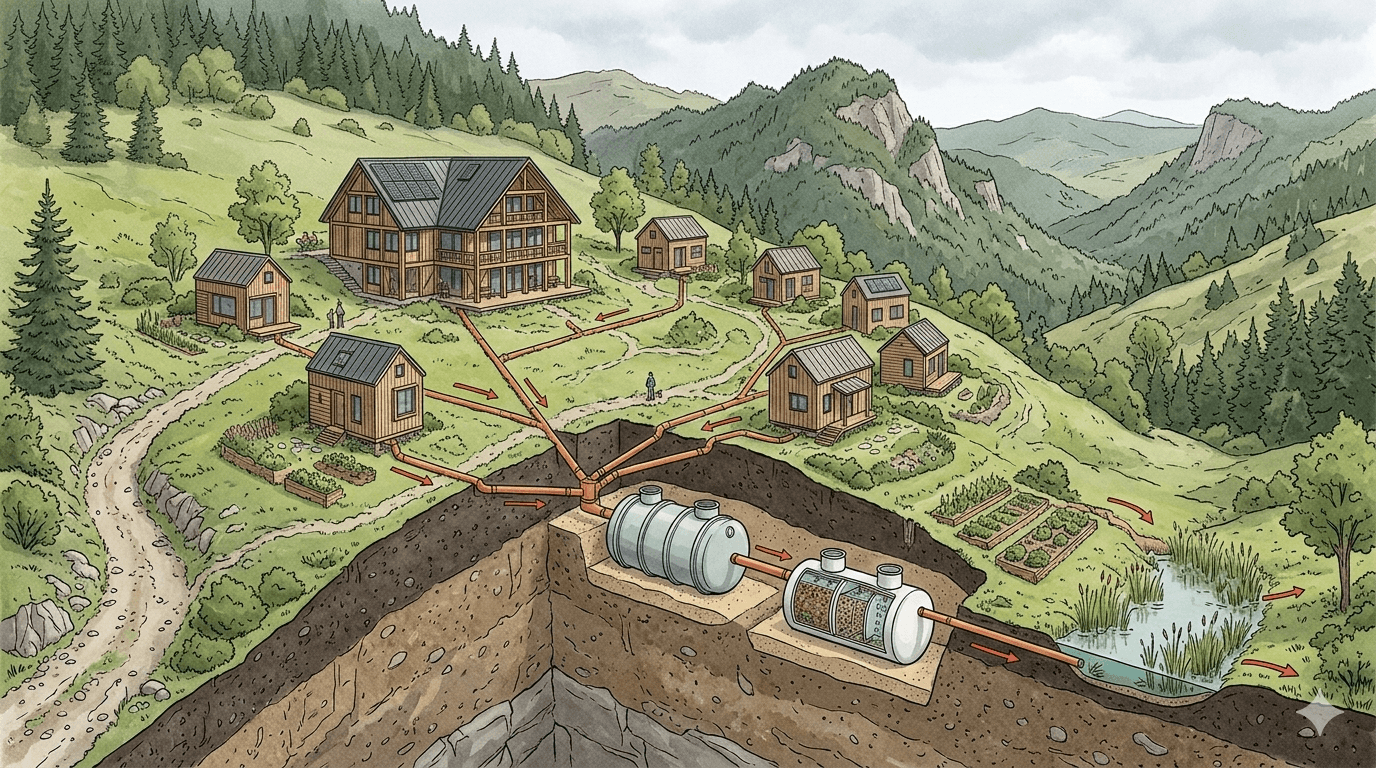
Once we stepped back from the Unity Hub-only question, the scope changed. Tepla Gora is not one building. It is a growing community — Unity Hub plus ten or more tiny houses on the same plot, all needing sanitation and water. Designing per-building systems multiplies every problem: cost, maintenance, pump-out logistics. A centralized system solves them once.
The design we arrived at has three parts.
A centralized aerobic septic, 20-25 m³. A single buried four-chamber tank serving every building on the plot. Wastewater flows by gravity from Unity Hub and all tiny houses to the central system. The first chamber (~6 m³) uses fine-bubble diffuser aeration — aerobic bacteria break down organics, removing 95-99% of BOD. The remaining chambers handle settling and effluent storage. One diaphragm air pump (~150W) runs intermittently, drawing about 1.8 kWh per day — a single 400W solar panel with a small battery covers it.
Everything connects through standard plumbing: toilets, showers, sinks, laundry. No urinals. No incinerating toilets. No separate systems per building. The sanitation design inside Unity Hub becomes conventional, which is what the architects need to hear right now.
Treated water from the final chamber returns for toilet flushing, with UV disinfection to prevent biofilm. This cuts fresh water demand. (This part was later dropped; see the September 2026 update below.) Surplus goes to garden irrigation — the effluent is nutrient-rich and works as fertigation. Sludge accumulation at this volume and with aerobic digestion is minimal: pump-out drops to once every 3-5 years, or never if a small on-site drying bed handles it.
Underground water storage, ~50 m³. Same construction method as the septic — excavated pit, concrete floor, brick or block walls, waterproof lining, ceiling. This stores water collected from streams (available roughly half the year) and rainfall. It replaces the clay-wall pond concept: no evaporation, no freezing, no landscape intervention. Potable-grade lining rather than septic-grade. 50 m³ is a fivefold increase over the current ten IBCs.
Biogas stays, but only for kitchen scraps. The HomeBiogas 4 unit moves outside Unity Hub and runs on food waste during warm months (April through October), producing cooking gas for the communal kitchen. It is not connected to the sanitation system. If it stalls, nothing else is affected. This is the separation we argued for earlier — now made concrete.
Both underground structures are built the same way: excavate with a backhoe, pour a concrete floor, build walls with bricks or blocks, apply waterproof membrane, install equipment, cast a ceiling, backfill. The community builds them. The septic can be tested with Unity Hub alone before tiny houses connect, validating the biological process at partial load.
For Unity Hub specifically, this simplifies the building. The technical room no longer needs to accommodate a digester, gas plumbing, or gas safety systems. It still needs space for heating equipment, a heat accumulator (500-1000 litre water tank), inverters, and HVAC — but the footprint is smaller and the safety requirements are simpler.
What this taught us
The partner's challenge was useful because it came from years of daily use, not theory. It forced us to evaluate our own proposal against a system that millions of people in Ukraine rely on. Some of what we found confirmed our original thinking. Some of it did not.
Daily sanitation and experimental energy systems should not share a single point of failure. If connecting them means that a stalled reactor leaves people without a toilet, the design is wrong regardless of how good the reactor is on paper.
Site constraints are design constraints, not footnotes. The mountain road to Tepla Gora eliminates any system that requires regular heavy vehicle access. Autonomous means autonomous, including from service trucks.
And the partner's trust in his own concrete ring system, built on years of quiet daily operation, is data that specifications cannot replace. We build within a community. If the community does not trust the system, the system has failed before it starts.
The primary sanitation technology was no longer an open question. A centralized aerobic system serving every building, built underground by the community. The core idea, separating what must be reliable from what we want to learn about, held up as the design matured. It just led somewhere more ambitious than we expected.
Then the team pushed back on the construction method itself.
The next pushback: concrete
We wrote up the proposal — four-chamber concrete tank with aeration, built on-site — and presented it to the Tepla Gora team. The technical logic was accepted. Centralized system, aerobic treatment, standard plumbing everywhere. Nobody argued with the design decisions.
The objection was about the concrete. At Tepla Gora, every sack of cement, every load of gravel, every meter of rebar has to come up a kilometer of steep mountain road. The team has done concrete work before and knows what it takes: formwork, mixing, pouring, curing, waterproofing every interior surface. Multiple weeks of skilled labor. For a community that builds with its own hands, the labor cost is real even when there is no paycheck.
The question was reasonable: are there manufactured systems that do the same job but ship as finished products?
A manufactured alternative
In Ukraine, several companies produce factory-made biological wastewater treatment systems in plastic tanks. We contacted Zelena Skelia, a Ukrainian manufacturer, and received a quote for their ZS-25: rated for 25 people, 5 m³/day.
The quote came in at 296,000 UAH (~$7,200) for the equipment. Their "consultant on your site" service adds about 10%: they design the layout, supervise installation, and commission the system. The community provides labor. Delivery to the site is on the buyer.
The system is two plastic units. A 7 m³ three-chamber settling tank handles primary treatment: gravity separation of solids, grease trapping, and clarification. A 1.2 m³ bioreactor with proprietary plastic ring media handles biological polishing. Together they weigh 510 kg, movable without a crane. Installation: dig a pit, lower the tanks, anchor with nylon straps to small concrete pads (50x50 cm), insulate, connect pipes, backfill with sand. No formwork, no rebar, no block walls, no multi-layer waterproofing.
Twelve-year warranty on the body. Expected lifespan over 50 years. Max energy consumption: 1.5 kWh/day. Electronic controller with GSM module for remote monitoring.
Biofilter vs. aerotenk
The ZS-25 uses a different treatment technology from what we originally designed, and the difference matters for a mountain site.
Our concrete system was an aerotenk: bacteria float in water as suspended "active sludge," kept alive by a compressor pumping air through diffusers. The ZS-25 is a biofilter: bacteria grow as a film on plastic ring media, stacked inside the reactor. Oxygen reaches the biofilm through natural ventilation. Air enters from below, water trickles down from above. No compressor. No forced aeration.
The practical difference: an aerotenk depends on its compressor. Power out for more than about two hours, the suspended bacteria begin to die, the system stalls, restart takes weeks. A biofilter's biofilm survives up to three weeks without power, because the passive airflow continues regardless.
Zelena Skelia frames "no air pump" as a feature. In the Carpathians, where power outages happen every winter, they have a point. A system that degrades gracefully without electricity is worth more than one that needs a UPS to stay alive.
The trade-off: without forced aeration in the primary settling stage, sludge breaks down more slowly. More residual sludge accumulates. Which brings us to the one question that matters.
The pump-out question, again
The manufacturer specifies pump-out every 12-24 months.
This loops back to the mountain road problem from earlier in this article. We ruled out the concrete ring septic partly because pump-out trucks might not reach the site. Now the biofilter system brings the same dependency, at a different frequency.
Two things make us think it is manageable.
First, road access will be tested before the septic goes in. Unity Hub construction requires deliveries of building materials, equipment, possibly a backhoe. By the time the septic is installed, the team will have real data on what vehicles can make it to the site. They can contact pump-out operators directly and get a straight answer.
Second, if truck access turns out to be impractical, there is an on-site fallback: a submersible sewage pump draws settled sludge from the tank once a year, and the sludge goes to a lined drying bed with sand and gravel layers. Water drains, solids dry, and after 6-12 months of composting, the residue is a soil amendment. This is standard practice for off-grid installations, and it fits the site well.
Where things stand now
The sanitation design has gone through three iterations.
First: a biogas-centered closed loop for Unity Hub alone. Rejected because it mixed experimental energy production with daily sanitation, and because scaling it to multiple buildings meant multiplying every problem.
Second: a community-built concrete aerobic tank serving all buildings. The treatment design was sound, but the construction method was wrong for the site.
Third, and current: a manufactured plastic biofilter system (Zelena Skelia ZS-25) with the same gravity sewer network connecting every building. The treatment technology handles power outages better than the aerotenk we originally designed. And nobody has to pour concrete on a mountainside.
The centralized approach stays. One system serves Unity Hub and all future tiny houses. Gravity sewer from each building. Standard plumbing everywhere. The underground water storage (50 m³) still uses concrete, because it has different requirements and benefits from a custom shape. Biogas from kitchen scraps remains unchanged.
The next steps are practical. The team investigates road access and contacts pump-out operators. If the price is accepted by the community, this becomes the finalized sanitation plan. The on-site drying bed gets designed as Plan B regardless — it is useful even if the truck can reach the site.
Update, September 2026: the fourth iteration
Seven months on, the plan above has changed in three ways. Each reversal has a reason, so it belongs in the record.
Centralized became per-building. In May the team decided that each plot on the site keeps its own septic. The hostel gets a separate unit, and the tiny houses will get theirs when they are built. The Unity Hub septic serves Unity Hub only. The engineering case for one shared system still stands, but a site-wide sewer ties one building's sanitation to a master plan that does not exist yet. The community chose independence over the larger system.
The tank got smaller. Sized for one building instead of a community, the ZS-25 gave way to the ZS-12 from the same manufacturer, rated for twelve people. A budget round in June settled it. The unit has been ordered.
The position is fixed. The tank sits a few metres from the building, at the point where the two Ø110 outlets from the foundation meet. An earlier plan placed it at the parking area, 70 metres away with an 11 metre fall, which called for a long Ø160 run with inspection chambers. In August the team moved it to within 30 metres, and in September right beside the building, which removed the long run entirely. Ground works on Unity Hub began in August, and the tee that splits the sewer riser between floors was cast into the foundation slab before the pour.
What changed downstream. Flushing toilets with treated effluent is off the table. At the parking location it would have needed an 11 metre lift, and the idea was not revived when the tank moved. Treated water now goes to an infiltration field. Its position is still open, with one constraint: it must not sit uphill of VodaLab, the community's water store. The underground 50 m³ reservoir was dropped for lack of budget. The team now prefers a well about 50 metres deep, a choice we argued against in the water-supply article and still question. The HomeBiogas unit for kitchen scraps was quietly shelved.
What is still open. The pump-out question has come back. The parking area was chosen partly because a truck can reach it. Nobody has yet confirmed that a truck can reach the new position, so the drying bed stays as Plan B. No geological survey has been done, so groundwater level and soil percolation at the tank and the infiltration field are still assumptions. If the well is drilled, the protection distance between the field and the well needs a proper check.
What held. Daily sanitation stays separate from experimental energy recovery. Biofilter over aerotenk. Standard plumbing inside the building. The mountain road as a design constraint. And the lesson from the first pushback: the design that gets built is the one the community trusts.
This investigation is part of the Unity Hub sanitation system design within the UA Unity Hub project at Tepla Gora. Related: Designing autonomous water supply for a Carpathian eco-community.
Article Details
- Published
- February 16, 2026
- Updated
- September 19, 2026
- Related Project
- UA Unity Hub